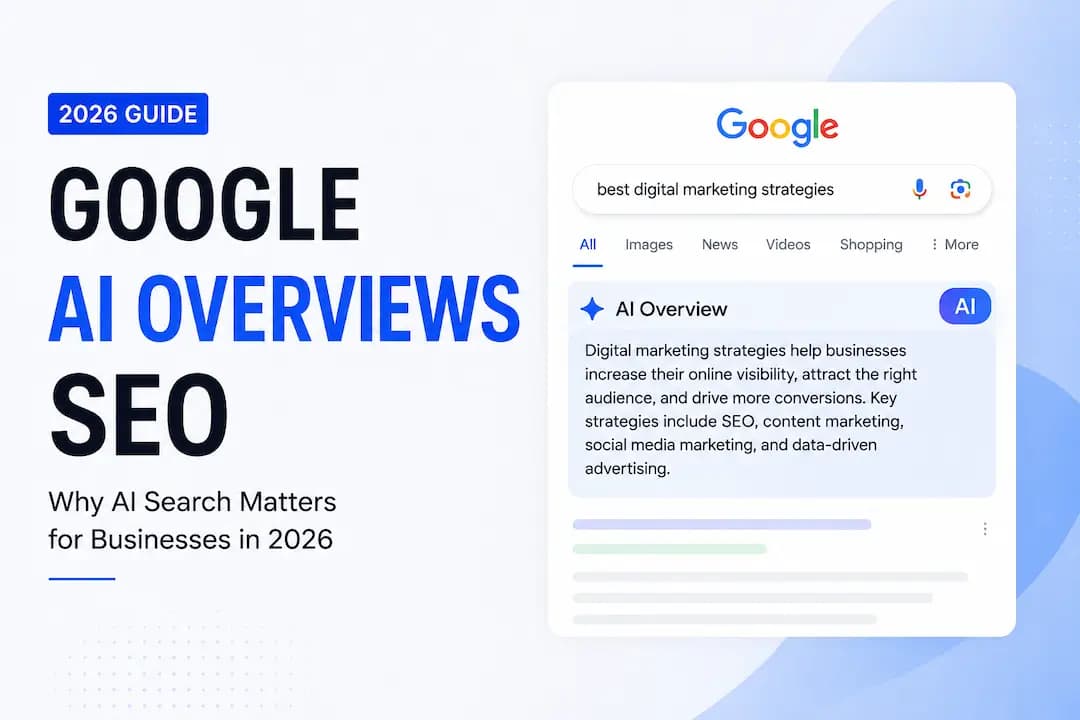
Google AI Overviews SEO focuses on optimizing your website and content to improve visibility in Google AI Overviews.
What is Google AI Overview and AI Mode?
Google AI Overview is an automated, AI-generated summary of your search query parameters that is displayed at the top of browser search results for quick answers. Google AI generates results using Gemini AI, and its AI Mode provides a fully interactive, conversational (chatbot-style) search experience.
We can ask further questions to learn about topics in depth and get more overview results, and we can use text, voice, or images to research more deeply.
Why AI Search Matters for Businesses in 2026.
AI searches are already incredible and increasing day by day. In 2026 AI is no longer the future—it's the present.
2.5+ billion monthly users now use Google AI Overviews
1+ billion monthly users use Google AI Mode.
900+ million monthly users use the Gemini app as of 2026.
ChatGPT has reached 900+ million weekly active users.
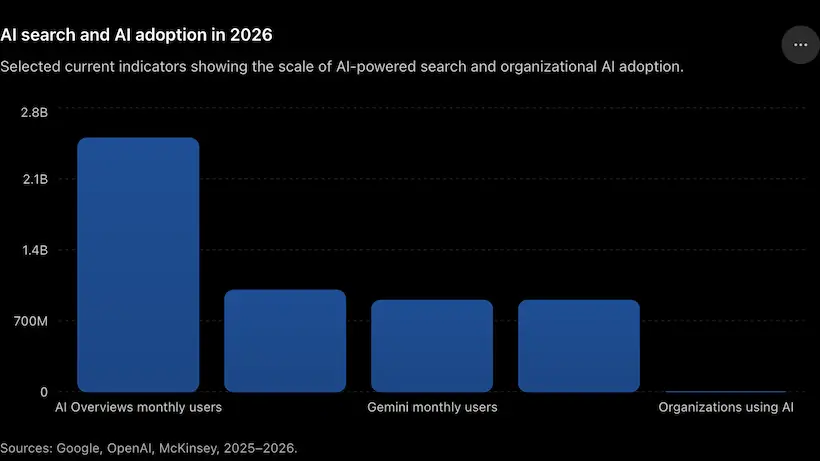
Businesses are increasingly adopting AI, and AI is changing user search behaviour. Based on Google reports, AI Overviews are generating 10%+ more Google usage for the types of queries where AI Overviews appear, including in the U.S. and India.
AI SEO 2026 isn't replacing search behaviour. It's changing how people discover, examine, analyze, and choose businesses. So now we've entered into an AI business war. If businesses want to stay competitive and want to achieve significant online growth, they need to start paying attention to AI search
Does Traditional SEO Still Work for AI Search?
Here is the main fact that we need to understand SEO is not dying—it's actively changing. The basic fundamentals of SEO—quality content, search intent, technical optimization, website performance, keyword targeting, backlinks, structured data, and user experience—remain key concepts for Google AI Overviews SEO and Google AI Mode SEO. But now ranking on Google SERP (search engine results pages) is no longer the only main objective.
Google AI Overviews and AI Mode are providing answers directly to users without wasting time on research on SERP and opening hundreds of tabs in the browser. Businesses need to improve their content relevance on both traditional search results and AI-generated answers. Your content has to be clear, informative, reliable, and easy for AI search systems to understand.
Note: As long as your content is reliable, informative, easy to understand, and uniquely identified, it will work.
How Google Selects Websites for AI Responses
Google wants to provide users the most relevant, helpful, and reliable information with accurate search intent. AI search doesn't simply look for websites that hold the top rankings in SERP. It looks for content relevance, credibility, trusted sources and overall quality content to understand which sources may provide useful information that can help answer a user's question.
Websites with clear, helpful, well-organised, and trustworthy information have a higher opportunity to be prioritised for AI-generated responses delivered to users. Effective traditional SEO principles also help search engines to identify, understand, and review your content.
10 Ways to Optimize Website for AI Search
Create high-quality content.
Create original content, and it must be accurate, trustworthy and useful. Make sure your content directly answers the users' questions in simple words, content relevancy matters a lot.
Understand what people really want
For AI overview suggestions your content needs to match users intent, whether users want to buy something or want to compare two products or services.
Build expertise around a topic
Cover the main topic completely. Create supporting content that deals with questions and subtopics.
Use structure for content
Organize content with clear intent and descriptive headings. Use paragraphs, lists, tables and quick answers. Make it easy for AI systems to understand.
Show. Trust
Showcase experience, expertise, skills and authority. Use information, author details, references, credentials and real-world experience.
Optimize for questions
Include frequently asked questions and answers (FAQs) that sound like how people actually ask questions when using AI-powered search.
Improve SEO
Make sure the website is easy for search engines to crawl and your website is fast (load under 3s), mobile-friendly and accessible.
Use structured data when
Add Schema.org structured data where it makes sense. It helps search engines to understand information about your pages, products, services and organization easily instead of relying entirely on Google to interpret your pages instead of providing additional context to Google in a standardised format.
Keep information accurate and up-to-date.
Review content regularly. Update information, statistics, facts and recommendations.
Optimize for both SEO and AI search
Do not stop using traditional SEO. Strong content, linking, backlinks, technical SEO, search intent and overall website quality are still important foundations for Google AI Overviews, SEO and AI-powered search visibility.
SEO vs GEO vs AEO: What's the Difference?
As we know, SEO (Search Engine Optimization) refers to the process of optimizing your website and content in order to enhance your website’s presence in SERP (Search Engine Results Pages).
To improve AI search optimization and your site's visibility, there are various factors to consider, including keyword optimization, quality content that people enjoy reading, ensuring good technical SEO, generating backlinks, using effective internal linking techniques, providing an excellent user experience, etc.
The primary goal of GEO (Generative Engine Optimization) is to improve AI (Artificial Intelligence)’s visibility by enhancing your rank on AI responses. This includes tools like Google AI Overviews, ChatGPT and other AI-powered search experiences.
Answer Engine Optimisation (AEO): It aims at providing precise and straightforward replies to the queries generated by the users. In other words, it tries to make your content understandable to both the search engines & AI systems.
How to Measure AI Search Visibility
Measuring AI search visibility is a little bit different from traditional SEO. You can't just check your Google ranking and assume your website is visible in AI search or not.
I usually recommend starting with the questions your potential customers might ask. Search those questions in Google AI Overviews and Google AI Mode. Is your website mentioned or linked? That's one of the simplest ways to check your visibility.
You can also track:
Google Search Console: Monitor impressions, clicks, rankings, and search queries.
AI Overviews & AI Mode: Check whether your website appears for important questions.
Website traffic: Use Google Analytics to track where your visitors are coming from.
Brand mentions: Check if AI tools mention your business for relevant questions or not?
Conversions: Track whether AI and organic search visitors are actually becoming customers.
There isn't one perfect indicator for AI search visibility yet. You have to look at several signals together, such as rankings, traffic, AI mentions, and conversions. The goal isn't just to appear in an AI answer; it's to get discovered by the right people.
Common AI SEO Mistakes
People make a lot of mistakes while doing AI SEO. We are going to discuss some common mistake that most people commit.
Overthinking: yes, this is the main common mistake that people make. They focused on keywords, AI tools, and getting mentioned in AI answers, but they get distracted from their goals, and ultimately they lost their focus on real user problems/issues, content quality and answering user questions.
Writing only for AI: Never forget that you are writing for users/humans, not for AI/bots. Write naturally. Answer the question. Keep it informative and helpful.
Relying too much on AI-generated content: AI is great for gathering ideas and research, but it can't be a replacement for your personal experience. Add your examples, opinions, and real-world information.
Ignoring traditional SEO: These days, people have started to ignore the fundamentals of SEO, and that's a huge mistake that people make. Technical SEO, keywords, internal links, backlinks, website speed, and user experience still matter. If your website or content fundamentals are weak, you may never rank for AI overviews and responses.
Forcing keywords: Inserting keywords forcefully (same keyword appears so many times and keyword stuffing) feels like AI-generated content, not natural. Don't do that. Use keywords naturally in content.
Publishing old information: Always try to keep updated. Use the latest information, facts, prices, statistics, tools, and recommendations. Check your content and update it when needed.
Ignoring search intent: Don't just focus on keywords. Ask, "What is this person actually trying to find?" In simple words, track the user interest.
Forgetting the website itself: it is possible that you may have quality content but still lose clients. Reasons: slow website, confusing layouts, not responsive on mobile etc.
AI Search Optimization Checklist
Before publishing your content, have a quick look at a few important aspects. It doesn't have to be difficult.
Understand search intent
Create useful content
Use keywords naturally
Keep content easy to read
Answer common questions
Show your expertise
Improve technical SEO
Improve website performance
Use structured data
Keep information updated
Build internal links
Don't forget traditional SEO
Check AI search visibility
The goal isn't to optimize everything for AI search. Create quality content, solve the real problems by answering the users questions, and apply the fundamentals properly on the website that makes it easy for search engines and AI systems to understand.
Conclusion
No doubt, AI search is changing the user search techniques for collecting information, products, and businesses online, but that doesn’t mean traditional SEO has vanished. The fundamentals of SEO still works, high-quality content, fast and secure websites, and user-perspective content.
Our main goal is not to optimize everything for AI, our main goal is to create quality content with the latest information and correct stats and information for users.
Need Help With AI SEO?
At IgniteShark we have expert professionals that are ready to help your business by improving your websites, SEO & online presence. If you're looking to optimize your website for AI-Powered Search with excellent traditional SEO, then get in touch with our experts today!
Ready to Improve Your Online Visibility? Let’s Talk